Carnauba, sealant or hybrid?
Carnauba wax
A natural wax from the leaves of a Brazilian palm, blended with oils and solvents to make it spreadable. Its appeal is entirely optical: it adds a warm depth that flatters dark paint in a way synthetics rarely match. Its weakness is that it is soft and melts at relatively low temperatures, so it degrades under sun, rain and detergent. Expect to reapply seasonally rather than annually.
Polymer sealant
Fully synthetic, engineered to bond to the clear coat and resist the things that break carnauba down. Durability is the entire point, and a good sealant applied in autumn will typically still be beading well into the following year. The look is cleaner and more reflective, which some people prefer and others find clinical.
Hybrids and graphene pastes
The modern middle ground: a paste or liquid that applies like a familiar wax but carries ceramic or graphene chemistry aimed at sealant-grade water behavior. The category is noisy with marketing — “graphene” is on everything now — so judge by beading and how long it lasts rather than the word on the tub. Done well, they are a genuine upgrade over pure carnauba for people who like applying paste.
Note that none of those three categories maps onto paste or liquid — both forms exist in each chemistry, and the form only changes how long the job takes and how evenly the coat goes down. Our paste wax vs liquid wax comparison separates the two questions properly, because mixing them up is why people buy the wrong tub.
Applying wax so it actually works
Most disappointing wax jobs fail for the same three reasons, none of them the product’s fault.
1. The paint was not clean
Wax seals the surface as it finds it. Applied over bonded contamination it locks the grime in and bonds poorly, so it looks patchy and fails early. The full sequence is wash, decontaminate, then protect — a proper wash first, and if the paint feels rough to a fingertip through a plastic bag, it needs decontaminating before any wax goes near it.
2. Too much product
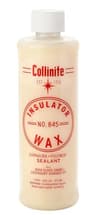
This is the big one. Wax works as an ultra-thin bonded film; anything beyond that is simply sitting on top waiting to be buffed away. A thick coat does not last longer — it just makes removal a fight and wastes product. Collinite 845 is notoriously unforgiving here: applied thinly it is superb, applied generously it is genuinely hard work to remove.
3. Wrong conditions
Work in shade, on cool panels, ideally not in high humidity. On a hot panel in direct sun, solvents flash off before the wax can level, which gives you streaking and a much harder removal. Do one panel at a time and buff before moving on.
How long will it really last?
Honestly: less than the box implies, and it varies more than any other factor in car care. A garaged car in a mild climate that gets washed with pH-neutral shampoo might hold protection for two or three times as long as an identical car parked outside through a salted winter and washed with a strong detergent.
The general ordering is reliable even when the numbers are not: pure carnauba is the shortest-lived, polymer sealants last considerably longer, hybrids sit between them, and spray ceramics outlast all of them. The single best thing you can do to extend any of them is wash correctly — harsh detergents strip protection far faster than weather does.
Do you even need wax?
A fair question, and the honest answer is that protection is optional but worthwhile. Modern clear coats are durable and a car does not rot because it went unwaxed. What protection buys you is a sacrificial layer that takes the UV, the acid rain, the bird lime and the road salt instead of your clear coat, plus a slicker surface that dirt sticks to less readily — which means easier, and therefore safer, washes.
If you want the effect without the labor, a spray ceramic is the modern shortcut. Our wax vs sealant vs ceramic guide lays the three options side by side on cost, effort and longevity.