What actually differs about washing an electric car
Start with what does not differ. The paint system on an EV is the same clear coat over base coat as anything else, so the same shampoos, sealants and coatings apply, and there is no reason to pay more for a bottle with a charging symbol on it. The differences are practical.
You will wash in places with no water supply. Garage parking and charger-adjacent parking are both common, and neither comes with a hose. That makes a rinseless concentrate the enabling product rather than a niche one — our no-driveway wash guide already ranked that method as the best compromise, and ONR is the bottle behind it.
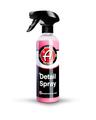
You will wash more often for less dirt. A car that is quietly dusty rather than road-filthy invites a quick wipe, and a quick wipe with the wrong cloth on a dry panel is the single most reliable way to install swirl marks. Two of the five picks here exist to make that wipe safe: Adam’s Detail Spray, which the maker also sells as a clay lubricant and drying aid and claims adds up to two extra months of wax life, and Turtle Wax’s Ceramic 3-in-1, a 32 oz detailer applied dry to a towel or a 2 ft by 2 ft panel which the maker states leaves hybrid ceramic protection and water beading behind. Neither publishes a durability figure, so we do not print one.
And you will probably be looking at a single dark or single light panel with very few interruptions in it. Large uninterrupted panels show wash marring more readily than a panel broken up by trim and creases, whatever the car. That is a reason to rank mitts and towels above chemicals, which is what this page does.
How we ranked these five
1. How likely is it to put a scratch in the paint?
The ranking criterion for the two contact items. The Cyclone mitt publishes its blend (70/30 microfiber) and comes as a single mitt; it does not publish a GSM figure, which we record as unknown rather than filling in. The Water Magnet is a waffle weave and publishes neither size nor GSM, so it is here on price and on being a dedicated drying towel rather than a repurposed cloth. If you want stated dimensions and twist-loop construction, that is the premium end of our drying towel ranking.
2. Can you use it with no hose and no runoff?
This is where ONR earns the second slot and where most product lists go quiet. Its published dilution is 1 oz per 2 gallons for rinseless use and it states under 2 gallons of water for a whole car, which is a figure you can plan a garage wash around: two buckets, a stack of towels, no rinse step and no water running down a shared driveway. Its stated safe-on list covering coatings, PPF and matte paint is the other half of why it is here — a lot of EVs are wrapped or coated, and most shampoos say nothing about either.
3. Does it work on a dry or nearly dry car?
Detail sprays and rinseless washes are not interchangeable. A detail spray is for dust and fingerprints on paint that is essentially clean; a rinseless wash is a real wash with a wash medium and a bucket. Using a detail spray on a genuinely dirty panel is grinding dirt into clear coat. The boundary is drawn properly on our detail spray ranking and in how to use rinseless wash.
4. Does it leave protection behind, and does the maker say how much?
Mostly they do not. Adam’s publishes a wax-life claim rather than a standalone durability figure. Turtle Wax states that its 3-in-1 adds hybrid ceramic protection and beading but publishes no interval. We treat both as top-ups rather than protection in their own right. If you want months of protection from one application, that is a ceramic spray, and for a car that is kept clean rather than restored, a spray is usually the whole answer.
Two things worth not buying
A pressure washer, if the car lives in a garage or a shared lot. Our pressure washer rankingsexist because a washer plus a foam cannon is the safest way to clean a filthy car, and that is still true — but a washer you cannot plug in next to a tap is an expensive thing to store. Rinseless first; add the washer when you have somewhere to use it.
And an automatic wash subscription. Brush washes are the most efficient marring machine ever invented, and the reason is mechanical rather than chemical: the brushes carry the previous car’s grit. We go into it in are automatic car washes bad for paint. Touchless washes are a different trade — harsher chemistry, no contact — and are a reasonable winter compromise on a protected car.