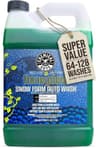
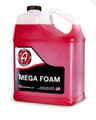
What each maker actually publishes
Every cell below is quoted or summarised from the maker’s own product page. Where a brand publishes nothing, the cell says so rather than borrowing a figure from a reseller or a review.
| | Adam’s Mega Foam | Chemical Guys Honeydew |
|---|
| Foam cannon dose | “1-2 ounces for Foam Guns and Foam Cannons” — no water volume given | “1 to 3 oz… to a 32 oz solution tank of foam cannon or gun” |
| Bucket dose | Not published | “Add 1 to 3 oz to 5-gallon bucket” |
| pH claim | “pH Neutral, Concentrated formula” | “pH-balanced”; “pH neutral formula won’t impact any coatings” |
| Numeric pH | Not published | Not published |
| Protection-safe claim | “will not remove wax, sealants, or degrade a ceramic coating” | “Safe for all exterior surfaces, including paint, wax, sealants, and ceramic coatings” |
| Concentration | “our most concentrated shampoo ever released” | Not quantified |
| Stated role | Any stage — pre-wash, or with a mitt for contact washing | Foam, then “Wash the surface with a wash mitt” — the word “pre-wash” is never used |
| Sizes | 16 oz, 16 oz 2-pack, gallon | 16 oz, 64 oz, gallon |
| Prop 65 warning | Not on the product page | Yes — names 1,4-dioxane |
The dilution problem, and why it decides this
Here is the practical difference, and it is bigger than it looks on the page.
Chemical Guys gives you a ratio: 1–3 oz into a 32 oz tank. That is a concentration you can reproduce in any cannon, because you scale it. Our MTM PF22carries a 1 L bottle, which is about 34 oz — near enough that the figure transfers directly. A 2 L bottle would want double.
Adam’s gives you an absolute quantity: 1–2 oz, with no water volume stated. In a 32 oz cannon that is a strong mix. In Adam’s own 1 L cannon it is slightly weaker. In a 2 L bottle it is half the strength and you will wonder why your foam is thin. We are not going to invent a ratio for Mega Foam that Adam’s has not published — but the practical reading is that Adam’s figure assumes a roughly 1 L cannon, which means it is comparable to the Chemical Guys dose rather than radically different.
Adam’s also publishes no bucket dose at all, which matters because the same page encourages bucket use. If you buy Mega Foam for a two-bucket wash, you are starting from nothing and adjusting by eye. Every published cannon figure we have found across the brands is collected in how much soap goes in a foam cannon.
Is either one actually a snow foam?
Worth untangling, because the two labels are used inconsistently by the brands themselves.
A true snow foamis a pre-wash: you cover a dirty car in thick foam, let it dwell, and rinse it off before you touch the paint with anything. The dwell is the point — it softens and floats off grit so your mitt has less to drag around. Chemical Guys’ own UK guidance is to leave snow foam on for “at least 5 minutes, but ideally closer the 10 minutes” without letting it begin to dry.
A contact shampoo is what goes in the bucket for the wash itself, where lubricity matters more than cling.
Honeydew is named as a snow foam and behaves like one, but Chemical Guys’ own instructions put a mitt wash immediately after the foam rather than describing a rinse-off pre-wash. Adam’s does not classify Mega Foam at all — it says explicitly that it works at any stage. So neither brand is drawing the line as cleanly as enthusiasts do. The practical answer: use either as a pre-soak, then follow with a contact wash, which is the routine in the safe wash method. Our snow foam vs car shampoo page is the full explainer on where the categories really divide.
Which to buy, by situation
You have a foam cannon and a coated car
Either works and both makers state coating safety outright. Buy Honeydew for the published ratio and the lower price. The one caveat is that neither brand publishes a numeric pH, so “neutral” is a claim rather than a measurement in both cases. Our soaps for ceramic-coated cars page covers what a coating actually needs from a shampoo.
You want one bottle for everything
Mega Foam, on Adam’s own framing. It is the only one of the two whose maker explicitly endorses using it at any stage of the wash, including as a pre-wash before claying or polishing. Being the more concentrated bottle also means a 16 oz goes further than a 16 oz of most things.
You wash a lot and cost per wash is the metric
Buy whichever is available in the largest bottle at the best price — both come in a gallon, and Honeydew also comes in a 64 oz. Mega Foam’s concentration claim argues in its favour on cost per wash, but neither brand publishes a washes-per-bottle figure and we are not going to compute one from a dose with no water volume attached.
You have no foam cannon
Then do not buy either of these yet. A snow foam in a bucket is just an expensive shampoo, and a snow foam through a garden-hose foam gun gives you thin suds rather than cling. Buy a cannon first — our budget cannon pickscost less than a bottle of premium soap — or buy a proper contact shampoo instead from the soap ranking.
You just want the cheapest thing that foams
The Sun Joe concentrate is on this page for that buyer, with a real caveat attached: Sun Joe publishes no pH, no coating-safe statement and no dilution for it. On an uncoated, waxed or bare car that is a tolerable unknown for the money. On a car wearing a coating you paid for, buy one of the two soaps whose maker has put the claim in writing.
Prices, and what we have not done
Live prices and the date they were read are on the cards above; we never type a number into the prose. In rough bands Honeydew is the cheaper of the two headline soaps, Mega Foam is the premium, and the Sun Joe concentrate sits below both.
To be explicit: we have not measured foam thickness, timed cling on a panel, tested pH with a meter or compared these two on the same car. Every claim above is the manufacturer’s own published wording, cited below with the date it was read, and the “Not published” rows — both numeric pH figures, Adam’s bucket dose, Honeydew’s concentration — are findings rather than gaps in our research. More on that in how we rank.