Swirl & Shine

Best Pressure Washers for a Foam Cannon

Thick foam is decided by flow rate, not pressure — the spec almost every buyer gets wrong. Three washers with the GPM to drive a cannon properly, and the connector detail that trips people up.

By Stephen V.Last updated How we rank

Almost everyone shops for a foam-cannon washer using the wrong number. The big figure on the box is PSI, so that’s what gets compared — but pressure is not what makes foam. Flow rate does. A foam cannon works by forcing water through a small orifice into a soap reservoir and out through a mesh that whips the mixture into lather. The volume of water moving through that mesh per minute is what determines how much foam comes out and how thick it is. That volume is GPM— gallons per minute — and it is the spec to buy on.

In practice, cannons generally start producing usable foam from around 1.2 GPMand get visibly better as you climb toward 1.7–2 GPM. Below that you still get foam, just thinner and slower to build. This is also why a high-PSI machine with modest flow can disappoint: all that pressure does nothing for lather. Every pick below is chosen for flow first, then checked against the roughly 1,200–1,900 PSIwindow detailers consider safe for clear coat — because a washer that foams beautifully but needs careful handling around paint is a bad trade. New to this? Start with the safe-PSI guide, then read how to use a foam cannon for the dilution side of the equation.

How this is funded:we earn a commission if you buy through our links, at no extra cost to you. It never changes which product we recommend, and we’ll always tell you who should skip one. Full disclosure.

Quick picks

Ranked on published specs, paint safety and buyer fit. Select a row to jump to the full write-up. We have not tested these products — here is exactly what we do instead.

#ProductBest forPrice
1
Sun Joe SPX3000 Electric Pressure Washer

Sun Joe SPX3000 Electric Pressure Washer

The default first pressure washer for car people, and for good reason: 2030 PSI and 1.76 GPM is right in the paint-safe window with a 40-degree tip, dual detergent tanks feed a foam cannon fine, and it costs less than a tank of gas over a competitor.

Best overall for foam
$194.74 · View on Amazon

$257.9925% off

Price as of September 4, 2026. #ad How we’re funded

2
Westinghouse WPX3000e Electric Pressure Washer

Westinghouse WPX3000e Electric Pressure Washer

A 3000-max-PSI electric that behaves like a small gas unit — steel wand, onboard soap tank, five nozzles. It's more washer than a car needs, which is exactly why the wide tips and standoff distance matter more here, not less.

Best flow for big vehicles
$242.49 · View on Amazon

$279.0013% off

Price as of September 4, 2026. #ad How we’re funded

3
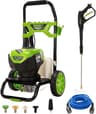
Greenworks 2300 PSI Electric Pressure Washer

Greenworks 2300 PSI Electric Pressure Washer

More muscle than the Sun Joe — 2300 PSI with a genuinely useful hose reel and a brushless-adjacent build quality — for people who also want it to clean a driveway. For car paint you'll dial it back with a wider tip, but the headroom is there.

Best for car plus driveway
$377.87 · View on Amazon

Price as of September 4, 2026. #ad How we’re funded

The picks in full

#1Best overall for foam

Sun Joe SPX3000 Electric Pressure Washer

The default first pressure washer for car people, and for good reason: 2030 PSI and 1.76 GPM is right in the paint-safe window with a 40-degree tip, dual detergent tanks feed a foam cannon fine, and it costs less than a tank of gas over a competitor.

Strengths

  • 2030 PSI / 1.76 GPM sits in the paint-safe range — enough to rinse foam, not enough to strip clear coat at a sane distance
  • Two onboard detergent tanks and five quick-connect tips out of the box
  • The most reviewed electric washer in the category, so parts and nozzles are everywhere

Trade-offs

  • Plastic quick-connect fittings feel cheap and can weep over time
  • Only a 20-foot hose and 34-foot cord — you'll be moving the unit around a full-size vehicle

Who should skip it. Skip it if you want a foam cannon on a 1/4-inch quick-connect without an adapter, or if you need to reach a driveway more than ~50 feet from an outlet.

Max pressure2030 PSI
Flow rate1.76 GPM
Motor14.5-amp electric
Hose length20 ft
Nozzle tips5 quick-connect (0/15/25/40 + soap)

Specs read from the product listing, on July 21, 2026. “Not published” means the maker doesn’t state that figure.

#2Best flow for big vehicles

Westinghouse WPX3000e Electric Pressure Washer

A 3000-max-PSI electric that behaves like a small gas unit — steel wand, onboard soap tank, five nozzles. It's more washer than a car needs, which is exactly why the wide tips and standoff distance matter more here, not less.

Strengths

  • 3000 max PSI and a pro-style steel wand — plenty of reach and grunt
  • Onboard soap tank plus a five-nozzle set covers every surface
  • Anti-tip footprint is more stable than the tall, narrow budget units

Trade-offs

  • 'Max PSI' is an unloaded figure — real working pressure is lower, and still high for paint
  • Overkill for a car-only buyer, and priced above the compact options

Who should skip it. Skip it for paint-only work — 3000 PSI tempts you into getting too close. Use the 40-degree tip only, or buy a gentler unit and remove the temptation.

Max pressure3000 PSI
Flow rate1.76 GPM
WandPro-style steel
Soap deliveryOnboard tank
Nozzle tips5-piece set

Specs read from the product listing, on July 21, 2026. “Not published” means the maker doesn’t state that figure.

#3Best for car plus driveway

Greenworks 2300 PSI Electric Pressure Washer

More muscle than the Sun Joe — 2300 PSI with a genuinely useful hose reel and a brushless-adjacent build quality — for people who also want it to clean a driveway. For car paint you'll dial it back with a wider tip, but the headroom is there.

Strengths

  • 2300 PSI with a real hose reel — the cord and hose management is a step up
  • Comes with multiple quick-connect nozzles including a soap tip
  • Handles patios, fences and siding as easily as the car

Trade-offs

  • At 2300 PSI you must respect standoff distance and tip choice on paint
  • Heavier and bulkier than a compact like the Karcher K1700

Who should skip it. Skip it if a car is all you'll ever wash — the extra pressure is headroom you'll deliberately never use, and a 1700-2000 PSI unit is easier to store.

Max pressure2300 PSI
Flow rate (max)Up to 2.3 GPM
MotorElectric, universal
Hose length25 ft
Nozzle tipsMultiple quick-connect + soap

Specs read from the product listing, on July 21, 2026. “Not published” means the maker doesn’t state that figure.

Why GPM, not PSI, decides your foam

It is worth being precise about the mechanism, because once you understand it the shopping decision becomes obvious. A foam cannon is a venturi device. Water enters under pressure, passes through a narrow orifice, and the resulting drop in pressure draws soap up out of the bottle. That soapy water is then pushed through a fine mesh screen, which aerates it into foam. Pressure gets the water moving through the orifice, but the quantity of aerated mixture leaving the mesh is a function of how much water is flowing.

So a machine with 3,000 PSI and 1.1 GPM will produce less foam than a machine with 1,800 PSI and 1.8 GPM. The first one hits the panel harder; the second covers it in lather. Since the entire point of a foam pre-soak is to sit on the paint and lift grit before your mitt touches it, coverage and cling are what you want. Pressure beyond the safe window is not just useless here — it is a liability you then spend the whole wash managing with tip choice and distance.

The rough flow tiers

  • Under 1.2 GPM— foam is thin and slow to build. Usable, but you will be topping up the reservoir and wondering why yours does not look like the videos.
  • 1.2–1.5 GPM— respectable foam. Most compact electrics live here, including the Kärcher K1700 at about 1.2 GPM. It works; it just is not lavish.
  • 1.6–2.0 GPM— the sweet spot for a car. Thick, clinging foam that covers a panel fast and gives you a proper dwell time.

The connector detail everyone forgets

The single most common foam-cannon disappointment has nothing to do with the washer at all: the cannon does not fit. Most foam cannons use a 1/4-inch quick-connectplug, which is the near-universal standard on aftermarket accessories. Several consumer washers — Kärcher in particular, but also some Sun Joe and Greenworks models — use their own proprietary bayonet lance fitting instead. The fix is a cheap brass adapter, but you have to know to buy one.

Before you order a cannon, look at the end of your washer’s wand. If it terminates in a square-shouldered metal stub with a sliding collar, that is a 1/4-inch quick-connect and any standard cannon will click straight on. If it is a round plastic collar that twists to lock, you need the brand’s adapter. It is a two-minute check that saves a return.

What else changes foam quality

Soap choice and dilution

The washer sets the ceiling; the soap decides whether you reach it. A dedicated snow foam is formulated to produce stable, long-clinging suds, while an ordinary wash shampoo foams lighter and collapses faster. If your foam looks thin on a high-flow machine, the soap is the first thing to change — see our snow foam roundup. Dilution matters just as much, and most people under-dose: the reservoir wants a genuine slug of concentrate, not a splash.

The cannon itself

A good cannon on a modest washer often out-foams a cheap cannon on a strong one. The orifice size and mesh quality are the variables, and the enthusiast-standard units use better versions of both. If you already own a capable washer and the foam still disappoints, the cannon is the upgrade — start with the foam cannon ranking or the budget picks if you would rather not spend much to find out.

Water hardness and temperature

Hard water suppresses lather — the same reason soap feels less sudsy in some regions. You cannot change your supply, but you can compensate with a slightly richer dilution. Cold water also foams a little less readily than tepid. Neither is a reason to buy a different machine, but both explain why two people with identical setups get different results, and it is worth knowing before you blame the hardware. If foam is still poor after all this, work through the troubleshooting guide.

Frequently asked questions

What GPM do I need for a foam cannon?

Around 1.2 GPM is the practical minimum for usable foam, and 1.6 to 2.0 GPM is where foam gets genuinely thick and clinging. Below 1.2 GPM a cannon still works but produces thin lather that builds slowly. Flow rate matters far more than PSI here, because the volume of water passing through the cannon's mesh is what creates and carries the foam.

Does higher PSI make thicker foam?

No. Pressure moves water through the cannon's orifice, but the amount of foam produced depends on flow volume through the aerating mesh. A 3,000 PSI machine with low flow will foam worse than an 1,800 PSI machine with high flow. Buying pressure for foam is the most common mistake in this category, and excess pressure is something you then have to manage carefully around paint.

Will my foam cannon fit my pressure washer?

Most foam cannons use a 1/4-inch quick-connect plug, which fits the majority of consumer electric washers. Some brands, notably Kärcher and certain Sun Joe and Greenworks models, use a proprietary twist-lock lance fitting and need an inexpensive adapter. Check the end of your wand before ordering: a square metal stub with a sliding collar is a quick-connect; a round twist-lock collar needs an adapter.

Can I use a foam cannon with a gas pressure washer?

Yes, and gas machines usually have plenty of flow for excellent foam. The catch is pressure: most gas units far exceed the roughly 1,200-1,900 PSI safe window for car paint, so you must use a wide tip and generous standoff distance. For a car specifically, an electric machine in the safe range is the easier and lower-risk choice, as our gas versus electric comparison explains.

Why is my foam thin even on a high-flow washer?

In order of likelihood: too little soap concentrate in the reservoir, an ordinary shampoo rather than a dedicated snow foam, a cheap cannon with a poor mesh, or hard water suppressing lather. Dilution is the most common culprit by a wide margin — most people use far less concentrate than a cannon needs. Fix the soap and dilution before you blame the machine.

Sources

Keep reading