Swirl & Shine

Best Pressure Washers for Mobile Detailing

Washing cars somewhere other than your own driveway changes the spec sheet completely. You stop shopping for pressure and start shopping for flow, a tank-fed inlet, universal fittings and a machine that survives being loaded in and out of a trunk every day.

By Stephen V.Last updated How we rank

For most mobile work, the Active 2.0 is the machine to buy. Two things decide it. First, 2.0 GPM of published flow — mobile detailing is paid by the hour and flow is what makes rinsing fast, while pressure mostly makes it risky. Second, the fittings: a 3/4-inch garden-hose inlet and an M22-14mm outlet mean the aftermarket gun, the longer hose and the foam cannonyou want thread straight on, with no adapter hunt in somebody else’s driveway. It is also built around a patented five-piston pump with a stated two-year residential warranty.

If you are not supplying your own water, none of the corded units above matter and the Worx Nitro Hydroshot is the pick. It draws from a bucket, a jug or a tank through its own intake hose, which is the one thing a mains-fed washer physically cannot do. At a published 710 PSI it is a rinser rather than a wash machine, and the battery is a real constraint — but for condo garages, office lots and anywhere with no spigot, it is the difference between working and not working.

A note on what this page is and is not. These are high-end consumer and prosumer-grade electric machines, not belt-driven commercial skids with a 200-gallon tank. If you are running a van with a reclaim mat and a buffer tank, you are shopping a different category than anything in our registry, and we will not pretend otherwise. What follows is honest about the duty cycle these units publish, and every figure is the maker’s own, read on the listing on the date shown on each card.

How this is funded: we earn a commission if you buy through our links, at no extra cost to you. It never changes which product we recommend, and we’ll always tell you who should skip one. Full disclosure.

Quick picks

Ranked on published specs, paint safety and buyer fit. Select a row to jump to the full write-up. We have not tested these products — here is exactly what we do instead.

#ProductBest forPrice
1
Active 2.0 Electric Pressure Washer

Active 2.0 Electric Pressure Washer

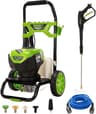
A detailing-crowd favorite that leads with flow rather than raw PSI — 2.0 GPM moves a lot of water, which rinses foam faster and more gently than a high-PSI/low-flow unit. Active builds it around a patented 5-piston pump and universal fittings, so the gun, hose and cannon you want thread straight on.

Best overall for mobile work
$299.99 · View on Amazon

Price as of October 17, 2026. #ad How we’re funded

2
Greenworks 2300 PSI Electric Pressure Washer

Greenworks 2300 PSI Electric Pressure Washer

More muscle than the Sun Joe — 2300 PSI with a genuinely useful hose reel and a brushless-adjacent build quality — for people who also want it to clean a driveway. For car paint you'll dial it back with a wider tip, but the headroom is there.

Best flow-plus-reach package
$364.30 · View on Amazon

Price as of October 17, 2026. #ad How we’re funded

3
Worx Nitro Hydroshot 20V (710 PSI)

Worx Nitro Hydroshot 20V (710 PSI)

The best cordless pick for cars: 710 PSI is plenty to rinse and spot-clean, and it draws from a bucket or lake, so you're not tied to a spigot. For a full detail it's a supplement to a corded unit, not a replacement — but as a grab-and-go rinser it's excellent.

Best with no water hookup
$164.99 · View on Amazon

Price as of October 17, 2026. #ad How we’re funded

4
Sun Joe SPX3000 Electric Pressure Washer

Sun Joe SPX3000 Electric Pressure Washer

The default first pressure washer for car people, and for good reason: 2030 PSI and 1.76 GPM is right in the paint-safe window with a 40-degree tip, dual detergent tanks feed a foam cannon fine, and it costs less than a tank of gas over a competitor.

Cheapest sensible start
$224.99 · View on Amazon

Price as of October 17, 2026. #ad How we’re funded

The picks in full

#1Best overall for mobile work

Active 2.0 Electric Pressure Washer

A detailing-crowd favorite that leads with flow rather than raw PSI — 2.0 GPM moves a lot of water, which rinses foam faster and more gently than a high-PSI/low-flow unit. Active builds it around a patented 5-piston pump and universal fittings, so the gun, hose and cannon you want thread straight on.

Strengths

  • 2.0 GPM flow rinses foam quickly at a paint-safe pressure
  • Universal 3/4-inch garden-hose inlet and M22-14mm outlet — aftermarket guns, hoses and cannons fit without hunting for an adapter
  • Patented 5-piston pump, backed by a stated 2-year residential warranty

Trade-offs

  • Premium price against mass-market Sun Joe / Greenworks units
  • The listing details the machine and its nozzles — a hose, gun and foam cannon aren't itemized, so check the bundle before you buy

Who should skip it. Skip it if you're price-sensitive — a Sun Joe SPX3000 does the paint-safe job for much less, and the extra flow is a nice-to-have, not a need.

Flow rate2.0 GPM
Max pressure1800 PSI (peak)
PumpPatented 5-piston
Fittings3/4" garden-hose inlet, M22-14mm outlet
Weight24 lb

Specs read from the product listing, on August 19, 2026. “Not published” means the maker doesn’t state that figure.

#2Best flow-plus-reach package

Greenworks 2300 PSI Electric Pressure Washer

More muscle than the Sun Joe — 2300 PSI with a genuinely useful hose reel and a brushless-adjacent build quality — for people who also want it to clean a driveway. For car paint you'll dial it back with a wider tip, but the headroom is there.

Strengths

  • 2300 PSI with a real hose reel — the cord and hose management is a step up
  • Comes with multiple quick-connect nozzles including a soap tip
  • Handles patios, fences and siding as easily as the car

Trade-offs

  • At 2300 PSI you must respect standoff distance and tip choice on paint
  • Heavier and bulkier than a compact like the Karcher K1700

Who should skip it. Skip it if a car is all you'll ever wash — the extra pressure is headroom you'll deliberately never use, and a 1700-2000 PSI unit is easier to store.

Max pressure2300 PSI
Flow rate (max)Up to 2.3 GPM
MotorElectric, universal
Hose length25 ft
Nozzle tipsMultiple quick-connect + soap

Specs read from the product listing, on July 21, 2026. “Not published” means the maker doesn’t state that figure.

#3Best with no water hookup

Worx Nitro Hydroshot 20V (710 PSI)

The best cordless pick for cars: 710 PSI is plenty to rinse and spot-clean, and it draws from a bucket or lake, so you're not tied to a spigot. For a full detail it's a supplement to a corded unit, not a replacement — but as a grab-and-go rinser it's excellent.

Strengths

  • 710 PSI — the strongest of the compact cordless washers, still paint-safe
  • Draws from any bucket or water source via the included hose
  • Shares batteries with the wider Worx 20V Power Share range

Trade-offs

  • Battery run-time limits you to a wash or two per charge
  • Low flow versus a corded unit means slower foam rinsing

Who should skip it. Skip it as your only washer if you do full two-bucket details — the battery won't last a whole wash, and a corded unit rinses far faster.

Max pressure710 PSI
Power20V Power Share battery
Water sourceBucket / open source or faucet
Flow rateNot published
NozzlesAdjustable + quick-connect

Specs read from the product listing, on July 21, 2026. “Not published” means the maker doesn’t state that figure.

#4Cheapest sensible start

Sun Joe SPX3000 Electric Pressure Washer

The default first pressure washer for car people, and for good reason: 2030 PSI and 1.76 GPM is right in the paint-safe window with a 40-degree tip, dual detergent tanks feed a foam cannon fine, and it costs less than a tank of gas over a competitor.

Strengths

  • 2030 PSI / 1.76 GPM sits in the paint-safe range — enough to rinse foam, not enough to strip clear coat at a sane distance
  • Two onboard detergent tanks and five quick-connect tips out of the box
  • The most reviewed electric washer in the category, so parts and nozzles are everywhere

Trade-offs

  • Plastic quick-connect fittings feel cheap and can weep over time
  • Only a 20-foot hose and 34-foot cord — you'll be moving the unit around a full-size vehicle

Who should skip it. Skip it if you want a foam cannon on a 1/4-inch quick-connect without an adapter, or if you need to reach a driveway more than ~50 feet from an outlet.

Max pressure2030 PSI
Flow rate1.76 GPM
Motor14.5-amp electric
Hose length20 ft
Nozzle tips5 quick-connect (0/15/25/40 + soap)

Specs read from the product listing, on July 21, 2026. “Not published” means the maker doesn’t state that figure.

The five things that matter away from home

1. Flow rate, because flow is time

In your own driveway an extra two minutes of rinsing costs nothing. On a paid job it is the margin. Flow rate — gallons per minute — is what sheets foam and dirt off a panel; pressure concentrates force on a small area, which on paint is the hazard rather than the feature. Detailer guidance puts the safe window for washing paint at roughly 1,200–1,900 PSI, so above that you are not buying speed, you are buying risk. Our PSI guide for cars covers why.

Flow is also what decides foam. Chemical Guys publishes a 1.4 GPM minimum and a 2.0 GPM recommendation for the TORQ Max Foam 8, which is the mainstream reference cannon. The Active 2.0 hits the recommendation exactly; the Greenworks 2300 publishes up to 2.3 GPM and clears it; the Sun Joe SPX3000 at 1.76 GPM is between the two figures. Nothing here is guesswork — see the PSI and GPM a cannon needs.

2. Where the water comes from

This is the question that actually sorts the list, and it has a hard answer. A mains-fed electric pressure washer needs a pressurised supply at its inlet; it will not suck water out of a drum. If the sites you work do not have a usable outdoor tap, your options are a cordless unit that draws from an open source, or a corded machine plus a separate feed pump and tank — which is a different purchase conversation.

Both cordless picks in our registry publish “bucket / jug / open source” as a water source, and that capability is the reason either is on the list at all. Our cordless roundup is the full set, and washing a car without a driveway covers the no-water, no-hose case properly.

3. Fittings, because a mismatch wastes a job

Consumer washers ship with proprietary or semi-proprietary connections, and discovering that on site is expensive. Two things to check before you buy:

  • The outlet thread. M22 is the de-facto standard, but M22 comes in 14mm and 15mm inner stems that will thread together and still leak. The Active 2.0 publishes M22-14mm, which is the common aftermarket size.
  • The cannon connection.Most cannons use a 1/4-inch quick-connect. Kärcher K-series machines use a bayonet instead, and the K1600–K2300 units need the quarter-inch model rather than the bayonet — a split the cannon makers publish themselves. Our cannon fitment decision guide walks through it, and the fitment reference lists the adapters.

4. Hose and cord length, because you cannot move the building

At home you position the machine once. On a job you are working around parked cars, kerbs and whoever else needs the outlet. A 25-foot hose on a reel — which is what the Greenworks 2300 publishes — is worth more than a spec-sheet improvement anywhere else, because every foot of hose is a foot you do not have to carry the machine. The Sun Joe SPX3000 publishes only a 20-foot hose and a 34-foot cord, which is the single most common complaint about an otherwise excellent cheap washer.

5. Duty cycle, honestly stated

None of these units publishes a duty-cycle rating, and we will not invent one. What we can say is what the makers do publish: the Active 2.0 states a patented five-piston pump and a two-year residential warranty — note the word residential. The others publish no warranty term on their listings at all. If you are washing four cars a day, five days a week, you are outside what any consumer electric was designed and warranted for, and you should budget for replacing the machine rather than assuming it will last.

The picks compared

 FlowPressureWater sourceNotable fitting / reach
Active 2.02.0 GPM1800 PSI (peak)Mains tap3/4" inlet, M22-14mm outlet; 24 lb
Greenworks 2300Up to 2.3 GPM2300 PSIMains tap25 ft hose on a reel
Worx Nitro HydroshotNot published710 PSIBucket, jug or open source20V Power Share battery
Sun Joe SPX30001.76 GPM2030 PSIMains tap20 ft hose, 34 ft cord; 5 tips

What to spend the rest of the budget on

A better machine is rarely the thing that improves a mobile wash. The order that actually matters:

  1. A proper foam cannon.A pre-soak is the biggest single scratch-reducer in the process, and an onboard soap tank cannot produce clinging foam — here is why. Our cannon ranking is the shortlist.
  2. Two buckets and grit guards.The cheapest insurance against putting swirls into a customer’s paint, and the fastest way to lose a repeat client if you skip it. See the two-bucket method and grit guards.
  3. Drying you can do fast and safely. Streaks are what the customer notices. A plush drying towel on panels and a blower for trim and wheels is the routine that stops water running out of mirrors ten minutes after you leave.
  4. A pH-neutral shampoo you can use on anything.You will not know what protection is on a stranger’s paint. A neutral soap that does not strip a coating removes the guesswork.

Prices, and what we have not done

Live prices and the date they were read are on the cards above; we never type a number into the prose. In rough bands the Sun Joe is the cheapest entry, the Greenworks and the Hydroshot sit in the middle, and the Active 2.0 is the premium of the four.

To be explicit, because this is a page aimed at people spending money to earn money: we have not run these machines commercially, logged hours on them, or measured flow at the nozzle. Every figure above is the manufacturer’s published specification carried in our registry with the date the listing was read, and the “Not published” rows — the Hydroshot’s flow rate, every unit’s duty cycle — are findings rather than omissions. More on that in how we rank.

Frequently asked questions

What pressure washer do mobile detailers use?

At the professional end, belt-driven commercial units fed from a tank on a van — a category no consumer electric belongs to. At the side-hustle and one-van end, the machines that get bought are high-flow prosumer electrics with universal fittings, because flow rate is what makes rinsing fast and universal threads mean an aftermarket gun, hose and foam cannon fit without an adapter. Our pick in that bracket is the Active 2.0 at a published 2.0 GPM with a 3/4-inch inlet and an M22-14mm outlet.

Can a pressure washer draw water from a tank or a bucket?

A mains-fed electric pressure washer cannot — it needs a pressurised supply at its inlet and will not siphon from an open container. Cordless units like the Worx Nitro Hydroshot and the Sun Joe 24V cleaner are built to do exactly that and publish bucket, jug or open water as a supported source. The other option is a corded machine plus a separate feed pump and buffer tank, which is a different and more expensive setup.

Is PSI or GPM more important for detailing work?

GPM, by a wide margin. Flow is volume of water, and volume is what carries foam and dirt away from a panel — which is what you are actually being paid for. Pressure concentrates force on a small area, which helps on concrete and hurts on clear coat; detailers generally work in a 1,200 to 1,900 PSI window on paint. Flow also decides foam thickness: Chemical Guys publishes a 1.4 GPM minimum and a 2.0 GPM recommendation for its TORQ Max Foam 8 cannon.

Will a consumer pressure washer survive commercial use?

Not indefinitely, and none of these units publishes a duty-cycle rating, so we will not pretend to know how long. The only warranty term published on these listings is the Active 2.0's two-year residential cover — note the word residential. If you are washing several cars a day, several days a week, treat the machine as a consumable and budget for replacement rather than assuming warranty cover will apply.

What fittings should I check before buying?

Two. First the outlet thread: M22 is the common standard but it exists in 14mm and 15mm inner stems that thread together and still leak, so match it to the gun and hose you intend to buy. Second the foam cannon connection: most cannons are 1/4-inch quick-connect, while Karcher K-series machines use a bayonet, and the K1600 to K2300 units need the quarter-inch model rather than the bayonet. Discovering either mismatch on a job site costs you the job.

Do I need a hot water pressure washer?

Not for washing paint. Hot water earns its keep on grease, engine bays and concrete, and hot-water machines are a commercial purchase with a burner, a different safety profile and a price that has nothing to do with the units on this page. For a wash-and-protect service, a cold machine with good flow and a proper foam pre-soak does the work.

Sources

Keep reading