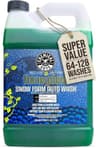
What Mr. Pink is known for, in the maker’s own words
Chemical Guys sells it as “a premium pH-balanced car wash shampoo that delivers a deep clean while helping preserve wax, sealant, and other protective coatings”, built on “super-slick polymers and hyper-surfactants” that reduce friction to minimize swirls, and it states the thing that defines the product: it “rinses clean, leaving no residue”. It is rated for paintwork, glass, plastic, rubber, stainless steel, metal and aluminum, it is sold in four sizes from 16 oz to a gallon, and it works in a bucket, a foam cannon or a foam gun.
That is a genuinely good description of a maintenance shampoo and it is why the product deserves its reputation. “Leaving no residue” is a feature, not a shortfall — on a car wearing a coating you paid for, you want the coating’s own hydrophobics doing the work, not a film of wash conditioners sitting on top of them.
Two caveats are worth naming because they are the reasons the four sections below exist. The first is that no numeric pH value is published on the product page — “pH-balanced” is a claim about the formula being safe, not a figure you can check. The second is that no foam-cannon dilution ratio is published either. Chemical Guys gives you the bucket dose and nothing for the cannon, which is exactly the number you need if the reason you bought it was to make foam.
Reason one: you want the stronger published pH claim
This is the top pick’s whole argument. If your car wears a ceramic coating or a sealant, the spec that decides whether a shampoo shortens its life is alkalinity, and what you can compare is not the chemistry itself but what each maker is prepared to put in writing.
Adam’s publishes pH neutral and the explicit promise that it will not strip waxes, sealants or ceramic coatings. Griot’s publishes pH balanced and goes one better on scope, naming vinyl wraps alongside waxes, sealants and coatings — the only listing in our registry that does. Mr. Pink publishes “pH-balanced”. Meguiar’s Gold Class publishes no pH claim at all, only that it lifts contaminants “without removing preexisting paint protection”.
None of those is a measurement, and we would not pretend that “neutral” on a marketing page is a laboratory result. But when you are choosing between two products whose actual pH you cannot see, the one willing to use the stronger word is the rational pick, and Adam’s is also the only one that tells you it is formulated to let you wash in direct sun and to hold minerals in suspension so they rinse away instead of drying on the panel. On hard water that second claim is worth more than it sounds — our hard-water wash picks cover why, and our coated-car soap picks rank this whole question on published pH alone.
Reason two: you want the wash to leave something behind
Mr. Pink is a cleaner by design. If what you actually want is for the paint to look richer when you are done, no amount of the right technique with a pure shampoo will give you that, and the answer is a shampoo built the other way round. Meguiar’s Gold Class is sold as a car wash and conditioner that adds “conditioners to further enhance gloss and shine”, and it publishes the foam-cannon number Mr. Pink’s page does not: diluted at 5:1.
Two honest limits. Conditioners are residue, which is the thing Mr. Pink exists to avoid — so this is the wrong bottle in the week before you apply a sealant or a coating, because bonding does not like a conditioned surface. And the gloss is cosmetic and temporary: it is a look on the day, not protection, and it is not a substitute for a wax or a spray coating. If gloss plus something durable is the goal, the honest category is a wash-and-wax, and the full head-to-head on these two specific bottles is on Mr. Pink vs Gold Class.
Reason three: you bought it for cannon foam and the foam is thin
This is the most common disappointment with Mr. Pink and it is a category error rather than a product fault. A bucket shampoo has to rinse clean and lubricate a mitt; a snow foam has to cling to a dry panel for minutes without running off. Those are different jobs and they want different surfactant packages. Mr. Pink is good at the first and merely adequate at the second, and the missing cannon ratio on its page is a hint that the cannon is not where the product was aimed.
The honest answer here is a different Chemical Guys bottle rather than a different brand, and we would rather say that than steer you somewhere else: Honeydew Snow Foam publishes the actual cannon ratio — 1 to 3 oz into a 32 oz solution tank — as well as the bucket dose, it is described as pH-balanced with a formula that “won’t impact any coatings”, and it is built on hypersurfactants to produce thick clinging foam. Note what Chemical Guys does not say about it: the maker never calls it a pre-wash. Its published method is to foam, then wash with a mitt and rinse, which means the foam is a soak that reduces what the mitt has to drag, not a touchless wash.
If you are still getting thin foam after switching the soap, the problem is almost certainly the hardware or the dilution rather than the bottle. Our foam cannon ranking covers the flow window your machine has to clear, and foam cannon not foaming works through the causes in order.
Reason four: you have nowhere to use a hose
Worth including because it is the reason that no shampoo can answer. If you park on a street, in a shared lot, or anywhere a hose is banned, the alternative to Mr. Pink is not another shampoo — it is dropping the rinse step entirely. Optimum No Rinse uses substantive polymers that encapsulate dirt so it can be wiped away rather than flushed off, and Optimum publishes the figure that makes it viable: an entire vehicle on under two gallons of solution.
The condition is strict and we will not soften it: the car has to be lightly soiled. A rinseless wash on a winter-salted car is how you grind grit into clear coat. Use it as a maintenance wash between proper washes, not as a replacement for them. Our rinseless wash ranking sorts that field on published dilutions, and how to use a rinseless wash is the method.
The case for buying Mr. Pink anyway
Three reasons, and the first one is arithmetic.
It is the cheapest wash per bucket of anything here you can compute. That is not a brand opinion, it is the published dose against the published bottle sizes, and it holds even against the concentrate that markets itself on value.
Leaving no residue is the right default. A pure shampoo is the one product in this list that is never the wrong thing to use. It is safe over a coating, it is safe before polishing, it is safe before applying a sealant, and it never has to be stripped off before a protection step. Every other pick here has a situation where it is the wrong choice.
It is one bottle for the whole car. Rated for paint, glass, plastic, rubber, stainless, metal and aluminum, in sizes from 16 oz to a gallon, so you can buy a small bottle to try it and a gallon once you know.
What none of these change
No shampoo on this page prevents swirl marks. Soap reduces friction; what causes swirls is dragging grit across paint, and that is a technique problem with a technique fix — the two-bucket method, a grit guard, a clean wash mitt and a plush drying towel do far more for your paint than any choice on this page.
None of them removes bonded contamination either. If the paint feels gritty after a wash, that is fallout and tar, and it needs clay and an iron remover, not a stronger soap. And if the marks that bother you are white rings that reappear as the car dries, that is hard water rather than dirt — our water spot remover picks cover what actually takes those off.
If the shampoo is not the only bottle you are thinking of replacing, the same comparison runs across the rest of the range — drying towel, iron remover, one-step compound, snow foam and brushes — on our Chemical Guys alternatives page, which also names the three products we would not swap.