Swirl & Shine

Best Pressure Washers for Trucks and SUVs

A pickup has roughly twice the painted area of a hatchback and a roof you cannot reach. What that actually calls for is flow and hose length — not more pressure.

By Stephen V.Last updated How we rank

The instinct when you buy a washer for a full-size truck is to buy more PSI, and it is the wrong instinct. Paint on an F-150 is the same clear coat as paint on a Civic, and it has the same limit — roughly 1,200 to 1,900 PSI at a sensible standoff. Buying 3,000 PSI to wash a bigger vehicle does not clean it faster. It just gives you more pressure you have to deliberately not use.

What genuinely changes on a truck or a three-row SUV is volume and reach. There is more surface to rinse, more foam to lay down and apply, more sill and wheel arch caked in road film, and a roof you cannot see the middle of. Every one of those is answered by GPM (how much water per minute the machine moves) and by hose length (how far you can walk around the vehicle before you have to drag the unit). Those two specs are what make a big wash take thirty minutes instead of an hour.

The picks below are ranked on that basis: enough flow to rinse a large panel in one sweep and drive a foam cannon over a big body, enough hose to get round a long wheelbase, and a pressure figure you can keep inside the safe window by choosing the right nozzle.

How this is funded:we earn a commission if you buy through our links, at no extra cost to you. It never changes which product we recommend, and we’ll always tell you who should skip one. Full disclosure.

Quick picks

Ranked on published specs, paint safety and buyer fit. Select a row to jump to the full write-up. We have not tested these products — here is exactly what we do instead.

#ProductBest forPrice
1
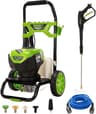
Greenworks 2300 PSI Electric Pressure Washer

Greenworks 2300 PSI Electric Pressure Washer

More muscle than the Sun Joe — 2300 PSI with a genuinely useful hose reel and a brushless-adjacent build quality — for people who also want it to clean a driveway. For car paint you'll dial it back with a wider tip, but the headroom is there.

Best overall for a truck
$377.87 · View on Amazon

Price as of September 4, 2026. #ad How we’re funded

2
Active 2.0 Electric Pressure Washer

Active 2.0 Electric Pressure Washer

A detailing-crowd favorite that leads with flow rather than raw PSI — 2.0 GPM moves a lot of water, which rinses foam faster and more gently than a high-PSI/low-flow unit. Active builds it around a patented 5-piston pump and universal fittings, so the gun, hose and cannon you want thread straight on.

Best flow for fast rinsing
$299.99 · View on Amazon

Price as of September 4, 2026. #ad How we’re funded

3
Westinghouse WPX3000e Electric Pressure Washer

Westinghouse WPX3000e Electric Pressure Washer

A 3000-max-PSI electric that behaves like a small gas unit — steel wand, onboard soap tank, five nozzles. It's more washer than a car needs, which is exactly why the wide tips and standoff distance matter more here, not less.

Most headroom for the yard too
$242.49 · View on Amazon

$279.0013% off

Price as of September 4, 2026. #ad How we’re funded

4
Sun Joe SPX3000 Electric Pressure Washer

Sun Joe SPX3000 Electric Pressure Washer

The default first pressure washer for car people, and for good reason: 2030 PSI and 1.76 GPM is right in the paint-safe window with a 40-degree tip, dual detergent tanks feed a foam cannon fine, and it costs less than a tank of gas over a competitor.

Best on a budget
$194.74 · View on Amazon

$257.9925% off

Price as of September 4, 2026. #ad How we’re funded

The picks in full

#1Best overall for a truck

Greenworks 2300 PSI Electric Pressure Washer

More muscle than the Sun Joe — 2300 PSI with a genuinely useful hose reel and a brushless-adjacent build quality — for people who also want it to clean a driveway. For car paint you'll dial it back with a wider tip, but the headroom is there.

Strengths

  • 2300 PSI with a real hose reel — the cord and hose management is a step up
  • Comes with multiple quick-connect nozzles including a soap tip
  • Handles patios, fences and siding as easily as the car

Trade-offs

  • At 2300 PSI you must respect standoff distance and tip choice on paint
  • Heavier and bulkier than a compact like the Karcher K1700

Who should skip it. Skip it if a car is all you'll ever wash — the extra pressure is headroom you'll deliberately never use, and a 1700-2000 PSI unit is easier to store.

Max pressure2300 PSI
Flow rate (max)Up to 2.3 GPM
MotorElectric, universal
Hose length25 ft
Nozzle tipsMultiple quick-connect + soap

Specs read from the product listing, on July 21, 2026. “Not published” means the maker doesn’t state that figure.

#2Best flow for fast rinsing

Active 2.0 Electric Pressure Washer

A detailing-crowd favorite that leads with flow rather than raw PSI — 2.0 GPM moves a lot of water, which rinses foam faster and more gently than a high-PSI/low-flow unit. Active builds it around a patented 5-piston pump and universal fittings, so the gun, hose and cannon you want thread straight on.

Strengths

  • 2.0 GPM flow rinses foam quickly at a paint-safe pressure
  • Universal 3/4-inch garden-hose inlet and M22-14mm outlet — aftermarket guns, hoses and cannons fit without hunting for an adapter
  • Patented 5-piston pump, backed by a stated 2-year residential warranty

Trade-offs

  • Premium price against mass-market Sun Joe / Greenworks units
  • The listing details the machine and its nozzles — a hose, gun and foam cannon aren't itemized, so check the bundle before you buy

Who should skip it. Skip it if you're price-sensitive — a Sun Joe SPX3000 does the paint-safe job for much less, and the extra flow is a nice-to-have, not a need.

Flow rate2.0 GPM
Max pressure1800 PSI (peak)
PumpPatented 5-piston
Fittings3/4" garden-hose inlet, M22-14mm outlet
Weight24 lb

Specs read from the product listing, on August 19, 2026. “Not published” means the maker doesn’t state that figure.

#3Most headroom for the yard too

Westinghouse WPX3000e Electric Pressure Washer

A 3000-max-PSI electric that behaves like a small gas unit — steel wand, onboard soap tank, five nozzles. It's more washer than a car needs, which is exactly why the wide tips and standoff distance matter more here, not less.

Strengths

  • 3000 max PSI and a pro-style steel wand — plenty of reach and grunt
  • Onboard soap tank plus a five-nozzle set covers every surface
  • Anti-tip footprint is more stable than the tall, narrow budget units

Trade-offs

  • 'Max PSI' is an unloaded figure — real working pressure is lower, and still high for paint
  • Overkill for a car-only buyer, and priced above the compact options

Who should skip it. Skip it for paint-only work — 3000 PSI tempts you into getting too close. Use the 40-degree tip only, or buy a gentler unit and remove the temptation.

Max pressure3000 PSI
Flow rate1.76 GPM
WandPro-style steel
Soap deliveryOnboard tank
Nozzle tips5-piece set

Specs read from the product listing, on July 21, 2026. “Not published” means the maker doesn’t state that figure.

#4Best on a budget

Sun Joe SPX3000 Electric Pressure Washer

The default first pressure washer for car people, and for good reason: 2030 PSI and 1.76 GPM is right in the paint-safe window with a 40-degree tip, dual detergent tanks feed a foam cannon fine, and it costs less than a tank of gas over a competitor.

Strengths

  • 2030 PSI / 1.76 GPM sits in the paint-safe range — enough to rinse foam, not enough to strip clear coat at a sane distance
  • Two onboard detergent tanks and five quick-connect tips out of the box
  • The most reviewed electric washer in the category, so parts and nozzles are everywhere

Trade-offs

  • Plastic quick-connect fittings feel cheap and can weep over time
  • Only a 20-foot hose and 34-foot cord — you'll be moving the unit around a full-size vehicle

Who should skip it. Skip it if you want a foam cannon on a 1/4-inch quick-connect without an adapter, or if you need to reach a driveway more than ~50 feet from an outlet.

Max pressure2030 PSI
Flow rate1.76 GPM
Motor14.5-amp electric
Hose length20 ft
Nozzle tips5 quick-connect (0/15/25/40 + soap)

Specs read from the product listing, on July 21, 2026. “Not published” means the maker doesn’t state that figure.

Why GPM matters more than PSI on a big vehicle

Think of it as two separate jobs. Pressure is what breaks the bond between a stuck-on contaminant and the paint. Flow is what carries the loosened dirt off the panel and away. On a small car both are over quickly. On a crew-cab pickup you are moving that dirt across a lot more square footage, and flow is the spec doing that work.

The practical difference is time. A 1.1 GPM machine and a 2.0 GPM machine at the same pressure will both eventually rinse a truck. The 2.0 GPM machine does it in roughly half the passes, because it is putting nearly twice as much water on the panel every second. On a vehicle this size that is not a nicety, it is the difference between a job you will actually do every two weeks and one you keep putting off.

Flow is also what decides your foam. A foam cannonneeds a minimum of about 1.2 GPM to produce anything worth calling snow foam, and thickens noticeably as you go up toward 1.7–2.0. On a big vehicle you also simply need morefoam — a 1 L cannon bottle that comfortably blankets a sedan will run dry partway down the side of a long-bed truck. Higher flow empties the bottle faster but covers far more panel while it does.

Hose length is the spec nobody checks

A 20-foot hose sounds generous until you are working around a vehicle that is nearly 20 feet long by itself. Once the machine is parked at the faucet you have maybe half a vehicle of usable radius, and you spend the wash dragging the unit over the driveway — which is how they get knocked over and how the inlet picks up grit.

Twenty-five feet is the realistic minimum for a full-size truck, and longer is better. If a machine you otherwise like ships with a short hose, an extension is cheap; just check the fitting on your gun first, because M22 comes in two internal sizes that thread together but do not seal. That is the same fitting problem that catches foam-cannon buyers.

The roof problem, and the honest answer

The center of a truck roof is out of reach from the ground for most people, and it is the single most common reason a big vehicle ends up half-washed. There are three workable answers and one bad one.

  • A long-handled wash brush or extension pole.The genuinely correct answer. A soft, flow-through brush on a pole reaches the roof center without you leaning on the bodywork, which is what actually scratches trucks — belt buckles and jacket zips against the bedside.
  • A step stool, used at the corners. Fine, and safer than climbing on the tire or the bumper step. Just keep the wash mitt off the paint until you are stable, because a mitt dropped on the driveway is a mitt that has to go back in the wash bucket.
  • Foam and let it dwell. The pre-soak is a bigger help on a truck than on any other vehicle, because it does chemical work on panels you can barely touch. Lay the foam thickly on the roof, let it sit its full few minutes, then rinse from a standoff. It will not fully replace contact, but it means the light contact you can manage is enough.
  • Do not climb into the bed and wash from there. Wet steel tread, soapy boots and a hard fall onto concrete is a genuinely common injury. It is not worth a clean roof.

Undercarriage and wheel wells, which matter more here

Trucks and SUVs sit higher, carry more exposed underbody, and are more likely to see gravel, farm tracks or salted roads. That makes underbody rinsing more valuable than on a low car — there is more surface holding salt and mud, and more frame steel for it to sit against.

The 40-degree tip and a wide sweep along the underside, the inner arches and behind the wheels does most of the work, and this is the one part of the wash where a bit more pressure is genuinely useful, because you are not aiming at clear coat. If you drive on salted roads in winter, do this every wash — salt is the fastest corrosion accelerator a vehicle sees, and the underside of a truck is where it collects.

What to buy if you are also washing the house

Many truck owners want one machine for the vehicle, the driveway and the siding. That is a slightly different question, and we answer it separately in pressure washers for cars and home. The short version: buy the higher-pressure unit and discipline yourself on nozzle choice, because you can always throttle a strong machine down with a wider tip, and you can never make a gentle one stronger.

If the vehicle is the only job, the opposite is true — buy for flow and hose length, keep the pressure moderate, and you remove the temptation entirely.
Frequently asked questions

What PSI do I need to wash a truck?

The same as any other vehicle: roughly 1,200 to 1,900 PSI at a sensible standoff distance, using a 40-degree tip on paint. A truck's clear coat is no tougher than a car's. Where a big vehicle genuinely differs is flow rate — aim for at least 1.5 GPM, and 2.0 GPM if you want to rinse a long body quickly.

Do I need a bigger foam cannon for a truck?

Not a bigger cannon so much as more soap solution and enough flow to drive it. A 1 L bottle that blankets a sedan will often need a refill partway around a crew-cab pickup. The more useful upgrade is a machine with higher GPM, because flow rate — not the cannon — sets how thick the foam is and how fast it goes on.

How do I wash the roof of a truck safely?

Use a soft, flow-through wash brush on an extension pole, or work from a stable step stool at the corners. Lay foam on the roof and let it dwell for several minutes first, which does much of the cleaning chemically. Do not stand in the bed to wash the roof — wet tread plate and soapy boots is a common way people get badly hurt.

Is a longer hose worth buying for a large vehicle?

Yes, and it is the cheapest upgrade on this page. Twenty-five feet is a realistic minimum for a full-size truck; anything shorter means dragging the machine around the driveway mid-wash. Check the fitting on your gun before ordering — M22 comes in 14 mm and 15 mm internal sizes that thread together but will not seal.

Should I pressure wash the undercarriage of my truck?

If you drive on salted or gravel roads, yes, and more often than you would on a car. Trucks carry more exposed underbody and frame steel for salt and mud to collect against. Use a wide tip and sweep along the underside and the inner wheel arches — this is the one part of the wash where extra pressure is useful, since you are not aiming at paint.

Sources

Keep reading