Swirl & Shine

Best Pressure Washers for Cars and Home

Most people buying a washer are not only washing a car. These are the machines with enough headroom for a driveway and siding that are still genuinely safe on paint — and the trade you accept to get both.

By Stephen V.Last updated How we rank

Our main pressure washer ranking optimizes for one thing: not damaging paint. That leads to gentle, compact machines, and it is the right answer if a car is genuinely all you will ever point it at. But most people buying their first washer are not in that position. There is also a driveway with two winters of algae on it, a fence, a patio, some siding, and a set of wheelie bins nobody wants to think about.

That is a different buying problem, and it deserves an honest answer rather than a fudge. The tension is real: hard surfaces want pressure and flow, and paint wants neither. The good news is that the tension is resolvable, because pressure at the nozzle is something you control with tip choice and standoff distance, not something the machine forces on you. A 2,300 PSI washer with a 40° tip held two feet back is delivering far less force to the panel than a 1,700 PSI machine with a 15° tip held six inches away. The machine sets your ceiling. Your technique sets what actually lands.

So the picks below are chosen on a different brief from the main ranking: enough capability to do real work on concrete, with a nozzle set and a build that makes dialing it back for paint straightforward rather than fiddly.

How this is funded:we earn a commission if you buy through our links, at no extra cost to you. It never changes which product we recommend, and we’ll always tell you who should skip one. Full disclosure.

Quick picks

Ranked on published specs, paint safety and buyer fit. Select a row to jump to the full write-up. We have not tested these products — here is exactly what we do instead.

#ProductBest forPrice
1
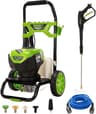
Greenworks 2300 PSI Electric Pressure Washer

Greenworks 2300 PSI Electric Pressure Washer

More muscle than the Sun Joe — 2300 PSI with a genuinely useful hose reel and a brushless-adjacent build quality — for people who also want it to clean a driveway. For car paint you'll dial it back with a wider tip, but the headroom is there.

Best overall for both
$377.87 · View on Amazon

Price as of September 4, 2026. #ad How we’re funded

2
Westinghouse WPX3000e Electric Pressure Washer

Westinghouse WPX3000e Electric Pressure Washer

A 3000-max-PSI electric that behaves like a small gas unit — steel wand, onboard soap tank, five nozzles. It's more washer than a car needs, which is exactly why the wide tips and standoff distance matter more here, not less.

Most hard-surface capability
$242.49 · View on Amazon

$279.0013% off

Price as of September 4, 2026. #ad How we’re funded

3
Active 2.0 Electric Pressure Washer

Active 2.0 Electric Pressure Washer

A detailing-crowd favorite that leads with flow rather than raw PSI — 2.0 GPM moves a lot of water, which rinses foam faster and more gently than a high-PSI/low-flow unit. Active builds it around a patented 5-piston pump and universal fittings, so the gun, hose and cannon you want thread straight on.

Best if the car comes first
$299.99 · View on Amazon

Price as of September 4, 2026. #ad How we’re funded

The picks in full

#1Best overall for both

Greenworks 2300 PSI Electric Pressure Washer

More muscle than the Sun Joe — 2300 PSI with a genuinely useful hose reel and a brushless-adjacent build quality — for people who also want it to clean a driveway. For car paint you'll dial it back with a wider tip, but the headroom is there.

Strengths

  • 2300 PSI with a real hose reel — the cord and hose management is a step up
  • Comes with multiple quick-connect nozzles including a soap tip
  • Handles patios, fences and siding as easily as the car

Trade-offs

  • At 2300 PSI you must respect standoff distance and tip choice on paint
  • Heavier and bulkier than a compact like the Karcher K1700

Who should skip it. Skip it if a car is all you'll ever wash — the extra pressure is headroom you'll deliberately never use, and a 1700-2000 PSI unit is easier to store.

Max pressure2300 PSI
Flow rate (max)Up to 2.3 GPM
MotorElectric, universal
Hose length25 ft
Nozzle tipsMultiple quick-connect + soap

Specs read from the product listing, on July 21, 2026. “Not published” means the maker doesn’t state that figure.

#2Most hard-surface capability

Westinghouse WPX3000e Electric Pressure Washer

A 3000-max-PSI electric that behaves like a small gas unit — steel wand, onboard soap tank, five nozzles. It's more washer than a car needs, which is exactly why the wide tips and standoff distance matter more here, not less.

Strengths

  • 3000 max PSI and a pro-style steel wand — plenty of reach and grunt
  • Onboard soap tank plus a five-nozzle set covers every surface
  • Anti-tip footprint is more stable than the tall, narrow budget units

Trade-offs

  • 'Max PSI' is an unloaded figure — real working pressure is lower, and still high for paint
  • Overkill for a car-only buyer, and priced above the compact options

Who should skip it. Skip it for paint-only work — 3000 PSI tempts you into getting too close. Use the 40-degree tip only, or buy a gentler unit and remove the temptation.

Max pressure3000 PSI
Flow rate1.76 GPM
WandPro-style steel
Soap deliveryOnboard tank
Nozzle tips5-piece set

Specs read from the product listing, on July 21, 2026. “Not published” means the maker doesn’t state that figure.

#3Best if the car comes first

Active 2.0 Electric Pressure Washer

A detailing-crowd favorite that leads with flow rather than raw PSI — 2.0 GPM moves a lot of water, which rinses foam faster and more gently than a high-PSI/low-flow unit. Active builds it around a patented 5-piston pump and universal fittings, so the gun, hose and cannon you want thread straight on.

Strengths

  • 2.0 GPM flow rinses foam quickly at a paint-safe pressure
  • Universal 3/4-inch garden-hose inlet and M22-14mm outlet — aftermarket guns, hoses and cannons fit without hunting for an adapter
  • Patented 5-piston pump, backed by a stated 2-year residential warranty

Trade-offs

  • Premium price against mass-market Sun Joe / Greenworks units
  • The listing details the machine and its nozzles — a hose, gun and foam cannon aren't itemized, so check the bundle before you buy

Who should skip it. Skip it if you're price-sensitive — a Sun Joe SPX3000 does the paint-safe job for much less, and the extra flow is a nice-to-have, not a need.

Flow rate2.0 GPM
Max pressure1800 PSI (peak)
PumpPatented 5-piston
Fittings3/4" garden-hose inlet, M22-14mm outlet
Weight24 lb

Specs read from the product listing, on August 19, 2026. “Not published” means the maker doesn’t state that figure.

Why one machine can do both jobs

The objection to a dual-purpose washer is that a machine powerful enough for concrete is dangerous near paint. That is half true, and the half that is wrong is the important half.

A pressure washer’s rated PSI is a measure of what the pump can generate, not what arrives at the panel. Three things sit between the two: the nozzle angle, which spreads that energy across a wider or narrower area, the standoff distance, because the jet loses force rapidly with distance, and how long you dwell in one place. A wide-fan tip at a sensible distance is a fundamentally different tool from a pencil jet held close, even out of the same machine on the same day.

This is why the safe-PSI question has a slightly more nuanced answer than the headline number suggests. Detailer guidance puts the safe working window for paint at roughly 1,200–1,900 PSI, and that is a good rule — but it is a rule about what lands on the panel. A higher-rated machine used correctly stays inside it. The full reasoning, the nozzle chart and the standoff numbers are in the safe-PSI guide, and if you buy anything on this page you should read it before the first wash.

Where the objection is right: a powerful machine gives you the capability to do damage, and capability plus impatience is how clear coat gets etched. If you already know you are the sort of person who will grab whichever tip is on the wand, buy a gentler machine and remove the option. That is a legitimate reason to skip everything on this page in favor of the under-$200 picks.

What the household jobs actually demand

It is worth being specific about the second job, because “home use” covers wildly different demands.

JobWhat it needsRealistic minimum
Washing a carWide tip, moderate pressure, decent flow1,400 PSI / 1.2 GPM
Rinsing bins, garden furniture, a bikeAlmost nothing — any washer does this1,400 PSI / 1.1 GPM
Siding and painted fencingFlow more than pressure; wide fan only1,800 PSI / 1.4 GPM
Patio slabs, decking, light algaeBoth, plus patience2,000 PSI / 1.6 GPM
Ingrained driveway staining, heavy mossFlow above all, ideally a surface cleaner2,300 PSI / 1.8 GPM

Notice how consistently flow climbs alongside pressure in that table. This is the spec people under-weight. On hard surfaces, pressure breaks the bond between dirt and substrate; flow carries the dirt away and determines how much area you cover per minute. A 3,000 PSI machine at 1.5 GPM will clean a driveway, eventually, in narrow unsatisfying strips. A 2,300 PSI machine at 2.3 GPM will finish sooner and look more even. The same logic governs foam and rinsing on a car, which is the subject of the foam cannon flow guide.

The accessory that changes the calculation

If a driveway or patio is a serious part of why you are buying, budget for a surface cleaner— the flat circular attachment with rotating jets under a shroud. It converts hard-surface cleaning from a slow striping exercise into something like mowing a lawn, and it produces an even result rather than the zebra pattern a bare wand leaves. It is the difference between using a dual-purpose washer for concrete twice and using it every spring. Check what your chosen machine’s connector and flow rating support before buying one.

How to switch between the two jobs safely

The practical risk with a dual-purpose machine is not the machine. It is switching tasks without switching setup — finishing the patio on a 15° tip, then starting on the car without thinking. Build a routine that makes that mistake structurally hard:

  1. Store the machine with the 40° tip fitted. Whatever you used last, put the white tip back on when you pack up. The default state of the tool becomes the safe one.
  2. Keep the aggressive tips somewhere separate. Not on the wand holder, not in the tray. Fitting a narrow tip should require a deliberate trip to get it.
  3. Do the car first if you are doing both. Cleaner mindset, cleaner equipment, and no risk of driveway grit sitting in a hose you are about to point at a fender.
  4. Test on a wheel arch or sill. First pass of the day, aim somewhere unimportant and check the distance feels right before you work across a door.
  5. Never use a turbo or rotary tip on a vehicle. Not on paint, not on trim, not on plastic wheel arch liners. That attachment exists for concrete.

When a dual-purpose machine is the wrong answer

Two situations where buying one machine for both jobs is a false economy.

The first is where the household job is genuinely heavy — a long driveway with years of ingrained staining, or commercial-scale work. Electric washers top out. If that is the real requirement, you are looking at a gas machine for the hard surfaces, and you should keep it well away from your car. The gas vs electric comparison covers why gas and paint are a poor pairing.

The second is where storage or noise decides it. These machines are bigger and heavier than a compact like the Kärcher K1700. If your storage space is a hall cupboard and your patio is four slabs, the honest recommendation is to buy the compact car washer and scrub the patio with a stiff brush twice a year.

What we would buy

For most people in this situation, the Greenworks 2300 is the right balance: enough pressure and flow to make hard-surface work worth doing, a hose reel that means you actually put it away properly, and a nozzle set that makes the car setting a deliberate choice. Step up to the Westinghouse WPX3000eonly if the household side is the bigger half of the job, and read that review first — its rated figure is a maximum, and the discipline it asks of you around paint is real. If you are honest that the car is the priority and the driveway is occasional, the Active 2.0’s flow-first design is the more pleasant machine to own, at a price that reflects it.

Frequently asked questions

Can one pressure washer safely do both my car and my driveway?

Yes, provided you change tips between jobs. What reaches the paint is set by nozzle angle and standoff distance, not by the machine's rated PSI — a 2,300 PSI unit with a 40-degree tip held about two feet back delivers less force to a panel than a weaker machine used carelessly up close. The practical risk is forgetting to switch, so store the machine with the wide tip fitted and keep narrow tips somewhere separate.

How much PSI do I need to clean a driveway?

Around 2,000 PSI will handle a patio and light algae; ingrained driveway staining and heavy moss realistically want 2,300 PSI or more. Flow matters just as much — at 2.3 GPM you cover far more area per minute than at 1.5 GPM, and the result looks more even. A surface cleaner attachment makes more difference to both speed and finish than another few hundred PSI does.

Is 2300 PSI too much for a car?

Not if you use it properly. 2,300 PSI is the pump's capability, not what lands on the panel. Fit a 40-degree or 25-degree tip, stay about two feet back and keep the wand moving, and the force reaching the paint sits comfortably in the roughly 1,200-1,900 PSI window detailers consider safe. What you must never do on a vehicle is fit a turbo, rotary or 0-degree tip.

Do I need a gas pressure washer if I also clean concrete?

Usually not. Electric units in the 2,300-3,000 PSI range handle domestic patios, decking, fencing and driveways, especially with a surface cleaner attachment. Gas becomes worth it for long driveways with years of ingrained staining or commercial-scale work — and if you buy one for that, keep it away from your car rather than trying to make it do both jobs.

What is a surface cleaner and do I need one?

It is a flat circular attachment with rotating jets under a shroud that you glide across concrete. It turns hard-surface cleaning from slow striping into something closer to mowing, and it produces an even finish rather than the zebra pattern a bare wand leaves. If a driveway or patio is a genuine reason you are buying a washer, it is the accessory to budget for before anything else.

Sources

Keep reading