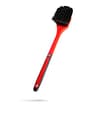
How to choose a detailing brush
Four questions. The first one removes most of what a search engine will show you, and the second is the only measurement that reliably predicts whether a brush is useful.
1. Is it an exterior brush or an interior brush?
These are not interchangeable, even though they look identical in a photograph. An interior detailing brush is built for dust on a dashboard: very soft, often with a long slim head for vent slats, and not expected to meet a chemical. An exterior brush has to carry a wheel cleaner or an all-purpose cleaner into a wet, gritty recess and survive being rinsed off and left in the sun.
The tell is the published job list. Chemical Guys names emblems, thin wheel spokes, slatted grilles, lug nuts, engine bays and exhaust tips. Mothers’ listing names wheels, engine bay, grilles and emblems. VIKING puts “exterior” in the product name. If a set’s own description leads with air vents, cup holders and leather seats, it was built for a different job — and this site has no use for it.
2. What are the bristles made of?
This is the one spec that decides whether a brush is safe near a finish you care about. Three materials turn up:
- Boar hair — natural, soft, holds liquid well, and the standard for anything that will touch a painted or clear-coated surface. The softest option and the one that wears fastest.
- Synthetic — usually nylon, more resistant to chemicals, keeps its shape longer. Stiffness varies enormously, which is exactly why a published word like “flocked” (tip-softened) is worth having.
- A boar and synthetic mix — what both of our top two picks publish. The intent is boar softness with synthetic durability. Neither maker publishes the ratio, so you cannot know how soft the mix is until it arrives.
One warning that matters more than any of the above: nothing in this category should be your tool for the wheel face. That is a different brush with a different shape, and our wheel brush roundup covers it, including the 17-inch barrel brush that reaches the part of a wheel these cannot.
3. What size is the head — and does the maker tell you?
This is the most useful number in the category and almost nobody publishes it. A brush is only useful if the head physically fits the gap you bought it for. A 1-inch head goes into a badge recess and between grille slats; a 1.5-inch head is for spoke roots, filler rings and seams; anything much bigger is a panel brush.
Of our four picks, exactly one publishes head diameters: VIKING states 1 inch and 1.5 inch. Chemical Guys publishes “three brushes of various sizes” and no dimension at all. Mothers publishes no size for its three-pack. Adam’s publishes a 20-inch handle and a 2-inch bristle head. That is the whole of the measured information available on this shelf, which is why VIKING ranks second on a listing with barely a paragraph of copy.
| What you want to clean | Head size you need | Pick |
|---|
| Badge surrounds, grille slats, tight trim gaps | About 1 in, soft | VIKING (published) or the smallest Chemical Guys head |
| Lug recesses, spoke roots, filler rings | About 1.5 in, soft | VIKING 1.5 in, or Chemical Guys mid head |
| Exhaust tips, engine bay, panel seams | Larger soft head, chemical-resistant | Chemical Guys 3-piece |
| Wheel wells, fender liners, underbody edge | Long handle, firm bristles | Adam’s Fender Brush |
| The wheel face and barrel | Not a detailing brush — a dedicated wheel brush | See our wheel brush picks |
4. Does the maker document the pack you are actually buying?
This sounds like a technicality until it costs you. Mothers publishes a product page for a two-brush “Detail Brushes” pack (part 90-156200), with a rubber seam-cleaning tip, extra-soft scratch-free bristles and a non-slip grip. The pack on sale at retail is a three-brush set. We cannot confirm the brush in the three-pack is the brush Mothers documents, so we rank it on the listing’s own claims and tell you about the gap rather than quietly borrowing the two-pack’s specs. It is a cheap brush set from a long-established brand, and that is as much as can honestly be said.
VIKING has the reverse problem: the head diameters are published, but on the retail listing rather than a maker page we could find. Chemical Guys is the only one of the four with a maker page for the exact set on sale, which is a real part of why it leads.
What we will not recommend, and why
The long-handle flow-through wash brush
Search for car brushes and you will be offered a 50-to-72-inch telescopic brush that screws onto a hose and sprays water through the head. We are not going to pick one. On an RV roof or house siding, fine. On car paint, a large stiff head on a long pole gives you no feel for what the bristles are dragging, and the grit it picks up off a lower panel goes straight back onto a door. If you cannot reach the middle of a roof, use a mitt on a step stool or a waterless wash and a towel — not a brush on a pole. The mistake list covers why.
The 26-piece mega-kit
The big-count kits that dominate the listings bundle three or four usable exterior brushes with a pile of interior vent tools, a tire dressing applicator and a microfiber or two. If the count is what you are buying, you are mostly buying the interior half of a kit you will not use on an exterior wash. Four good brushes beat twenty-six assorted ones.
Anything with wire bristles
Several popular sets include two or three small wire brushes. They have a legitimate use on rusted hardware and nothing whatsoever to do with cleaning a car you intend to keep looking good. A wire brush near a wheel face, a badge or any painted panel is permanent damage.
How to actually use them without causing damage
Three rules, and they are the difference between a brush that helps and a brush that leaves marks.
Never use a brush dry on paint. A dry bristle drags dry grit. Rinse the panel, apply your cleaner, let it dwell, and only then agitate. On a wheel that means the wheel cleaner goes on first and the brush follows it — the chemical does the work and the brush just moves it into the recess.
Keep one brush for wheels and one for everything else. Brake dust is embedded metal. A brush that has lived in a lug recess carries that metal in its bristles, and the one place you do not want it is a badge surround on a painted panel. Mark the handles. This is the same logic as the two-bucket method, applied to bristles.
Rinse them out and hang them to dry, bristles down. Cleaner left in boar hair breaks it down and grit left in the ferrule comes back out on the next wash. None of our four makers publishes any care instruction at all, which is a small scandal in a category where bristle life is the whole product — so this one is ours, not theirs.
Where brushes fit in the wash
Early, and on a wet car. The safe-wash sequence puts wheels first, before any paint, which is where the brushes get their hardest use — lug recesses and spoke roots with a wheel cleaner dwelling on them. Then, after the car is foamed and rinsed but before you dry it, the badge surrounds, grille slats, mirror bases and fuel filler ring with the cleaner still wet on the surface.
That last pass is also the one that shows up in photographs. Clean paint with a dirty badge surround reads as a car that was rushed; the badge is at eye level and it is where the eye goes. If you are following the full order of a detail, this is the step between decontamination and protection, and it is also the last chance to get cleaner out of a seam before a ceramic spray seals it in there.
So what should you buy?
Buy the Chemical Guys All in the Details Exterior Detailing Brushes if you want one purchase to cover the job properly. It is the only set from a major car-care brand that is sold as exterior-only, the only one with a maker page for the exact pack on sale, and the only one that publishes a finish list — accepting that the list names vinyl, plastic, rubber and metals and does not name paint, and that no dimension is published anywhere.
Buy the VIKING Exterior Car Detail Brush 2-pack if you want to know what you are getting. One inch and 1.5 inch, boar and synthetic, budget bracket. Two brushes instead of three, and a maker that publishes nothing else, but those two numbers are more than the rest of this shelf will tell you.
Buy the Mothers Car Detailing Brush Set if you are not yet sure you will use detailing brushes at all. It costs about as much as a bottle of soap, it names exterior jobs on the listing, and if it turns out you reach for brushes every wash you can upgrade knowing what sizes you actually want. Go in aware that Mothers’ own documentation is for a different pack size.
And add the Adam’s Fender Brush when the wheel wells start bothering you — not before. It is the only pick here with a published handle length, it keeps your knuckles out of a liner, and it does a job none of the small sets can touch. It also replaces none of them, which is why it is fourth rather than first.