Swirl & Shine

Greenworks 2300 vs Westinghouse WPX3000e

The two high-power electrics people cross-shop when one machine has to do the car and the house. The headline PSI says Westinghouse wins. The number that matters for washing a car says the opposite.

By Stephen V.Last updated How we rank

If a car is the main thing you are washing, buy the Greenworks 2300. It publishes up to 2.3 GPM against the Westinghouse’s 1.76 GPM, and flow rate — not pressure — is what rinses foam off a panel and what feeds a foam cannon properly. It also ships with a real hose reel and a 25-foot hose, so you walk around the car instead of dragging the machine. Its 2300 PSI is already more than paint needs; the extra half a gallon a minute is the part you will actually use.

Buy the Westinghouse WPX3000e if the house is the main job and the car is the side job. A 3000 max-PSI rating, a pro-style steel wand, an onboard soap tank and a five-nozzle set make it the better concrete, fence and siding machine of the two, with a wider anti-tip footprint than the tall budget units. On paint you will deliberately use one nozzle out of five and stand further back, which is a slightly strange way to own a washer.

And the honest third answer: most car owners should buy neither. Detailer guidance puts the safe window for washing paint at roughly 1,200–1,900 PSI. Both of these machines exceed that at the trigger, so the entire difference between them on a car comes down to which nozzle you fit and how far away you stand. If the car is all you will ever wash, the Kärcher K1700 at a published 1700 PSI removes the temptation entirely — that is why it is the third pick here. Everything below is each maker’s published figure as carried in our registry, read on the listing on the date shown on each card; we have not put a gauge on either machine.

How this is funded: we earn a commission if you buy through our links, at no extra cost to you. It never changes which product we recommend, and we’ll always tell you who should skip one. Full disclosure.

Quick picks

Ranked on published specs, paint safety and buyer fit. Select a row to jump to the full write-up. We have not tested these products — here is exactly what we do instead.

#ProductBest forPrice
1
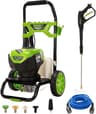
Greenworks 2300 PSI Electric Pressure Washer

Greenworks 2300 PSI Electric Pressure Washer

More muscle than the Sun Joe — 2300 PSI with a genuinely useful hose reel and a brushless-adjacent build quality — for people who also want it to clean a driveway. For car paint you'll dial it back with a wider tip, but the headroom is there.

Better for washing cars
$364.30 · View on Amazon

Price as of October 17, 2026. #ad How we’re funded

2
Westinghouse WPX3000e Electric Pressure Washer

Westinghouse WPX3000e Electric Pressure Washer

A 3000-max-PSI electric that behaves like a small gas unit — steel wand, onboard soap tank, five nozzles. It's more washer than a car needs, which is exactly why the wide tips and standoff distance matter more here, not less.

Better for the house
$279.00 · View on Amazon

Price as of October 17, 2026. #ad How we’re funded

3
Kärcher K1700 Electric Pressure Washer

Kärcher K1700 Electric Pressure Washer

The compact, paint-friendly pick. At 1700 PSI it's the closest thing here to a purpose-built car washer — enough to lift foam and grime, gentle enough that a moment of carelessness won't mar the clear coat. Kärcher build quality helps too.

Better if it is only ever a car
$189.99 · View on Amazon

$229.9917% off

Price as of October 17, 2026. #ad How we’re funded

The picks in full

#1Better for washing cars

Greenworks 2300 PSI Electric Pressure Washer

More muscle than the Sun Joe — 2300 PSI with a genuinely useful hose reel and a brushless-adjacent build quality — for people who also want it to clean a driveway. For car paint you'll dial it back with a wider tip, but the headroom is there.

Strengths

  • 2300 PSI with a real hose reel — the cord and hose management is a step up
  • Comes with multiple quick-connect nozzles including a soap tip
  • Handles patios, fences and siding as easily as the car

Trade-offs

  • At 2300 PSI you must respect standoff distance and tip choice on paint
  • Heavier and bulkier than a compact like the Karcher K1700

Who should skip it. Skip it if a car is all you'll ever wash — the extra pressure is headroom you'll deliberately never use, and a 1700-2000 PSI unit is easier to store.

Max pressure2300 PSI
Flow rate (max)Up to 2.3 GPM
MotorElectric, universal
Hose length25 ft
Nozzle tipsMultiple quick-connect + soap

Specs read from the product listing, on July 21, 2026. “Not published” means the maker doesn’t state that figure.

#2Better for the house

Westinghouse WPX3000e Electric Pressure Washer

A 3000-max-PSI electric that behaves like a small gas unit — steel wand, onboard soap tank, five nozzles. It's more washer than a car needs, which is exactly why the wide tips and standoff distance matter more here, not less.

Strengths

  • 3000 max PSI and a pro-style steel wand — plenty of reach and grunt
  • Onboard soap tank plus a five-nozzle set covers every surface
  • Anti-tip footprint is more stable than the tall, narrow budget units

Trade-offs

  • 'Max PSI' is an unloaded figure — real working pressure is lower, and still high for paint
  • Overkill for a car-only buyer, and priced above the compact options

Who should skip it. Skip it for paint-only work — 3000 PSI tempts you into getting too close. Use the 40-degree tip only, or buy a gentler unit and remove the temptation.

Max pressure3000 PSI
Flow rate1.76 GPM
WandPro-style steel
Soap deliveryOnboard tank
Nozzle tips5-piece set

Specs read from the product listing, on July 21, 2026. “Not published” means the maker doesn’t state that figure.

#3Better if it is only ever a car

Kärcher K1700 Electric Pressure Washer

The compact, paint-friendly pick. At 1700 PSI it's the closest thing here to a purpose-built car washer — enough to lift foam and grime, gentle enough that a moment of carelessness won't mar the clear coat. Kärcher build quality helps too.

Strengths

  • 1700 PSI is squarely in the safe range for automotive clear coat
  • Compact, upright footprint stores in an apartment closet
  • CETA-certified performance from an established pump brand

Trade-offs

  • Not enough grunt for heavy driveway or concrete cleaning
  • Onboard detergent tank is small; a separate foam cannon is better

Who should skip it. Skip it if you also want one machine for tough patio and siding jobs — 1700 PSI is deliberately mild, and you'll wish for more on concrete.

Max pressure1700 PSI
Flow rate1.2 GPM
CertificationCETA
Nozzles3 spray nozzles
DetergentOnboard tank

Specs read from the product listing, on July 21, 2026. “Not published” means the maker doesn’t state that figure.

The published numbers, side by side

 Greenworks 2300Westinghouse WPX3000e
Max pressure2300 PSI3000 PSI (max)
Flow rateUp to 2.3 GPM1.76 GPM
MotorElectric, universalElectric
Hose25 ft, on a reelNot published on the listing
WandStandardPro-style steel
NozzlesMultiple quick-connect, including a soap tip5-piece set
Soap deliverySoap nozzleOnboard tank
In the paint-safe window?No — above it; use a wide tipNo — well above it; use the 40° tip only

Why GPM beats PSI on a car, every time

This is the single most misunderstood thing in the category, and it is the reason the machine with the smaller headline number is our pick for cars.

PSI is force concentrated on a small area.On a driveway that is exactly what you want — you are trying to break a bond between dirt and concrete. On automotive clear coat, force is the hazard: it is what lifts a chip into a peel, drives water past a trim seal, and tempts you to get close enough to mar a panel. Our guide to PSI for cars covers the window in detail.

GPM is volume of water delivered. Volume is what carries dirt and foam awayfrom the paint rather than pushing it along. It is why a 2.3 GPM machine rinses a foamed car noticeably faster than a 1.76 GPM one at a higher pressure, and it is the figure that decides how thick your foam is: a cannon’s foam quality is set by flow through the orifice, not by pressure at the pump.

The Chemical Guys TORQ Max Foam 8, which we use as the reference cannon because it publishes its window, states a minimum of 1.4 GPM with 2.0 GPM recommended. The Greenworks clears the recommended figure. The Westinghouse clears the minimum but not the recommendation. That is a real, published difference in how well each machine will foam.

“Max PSI” is not working pressure

Worth saying plainly, because 3000 on a box is persuasive: a max-PSI rating is measured in a condition you never actually wash in. Real working pressure at the nozzle, with a tip fitted and water flowing, is lower — sometimes substantially. We carry the number the maker publishes because that is what is published, and we flag it as a maximum, not as what the machine delivers while you hold the trigger.

That cuts both ways. It means the Westinghouse is less terrifying on paint than “3000 PSI” sounds. It also means you cannot treat the two numbers as directly comparable in the way the GPM figures are, since both makers measure max pressure the same optimistic way but flow is flow.

Which one should you actually buy?

Buy the Greenworks 2300 if…

  • The car is the reason you are buying a pressure washer, and the driveway is a bonus.
  • You want to run a foam cannon and you want thick foam without thinking about it.
  • Hose management matters to you. A 25-foot hose on an actual reel is the quality of life difference you notice every wash, and it is why this machine is also our pick in washers for trucks and SUVs, where reach is the constraint.

Buy the Westinghouse WPX3000e if…

  • You have concrete, pavers, a fence or siding that a 2300 PSI machine has been struggling with.
  • You want a steel wand and a stable, anti-tip base — it handles more like a small gas unit than a consumer electric.
  • You will genuinely discipline yourself to the 40-degree tip and a long standoff on paint. If you will not, this is the wrong machine, and we say so in its own skip line.

Buy the Kärcher K1700 if…

  • A car is all you will ever wash. At 1700 PSI and 1.2 GPM it sits inside the paint-safe window by design, it is CETA-certified, and it stores in a closet.
  • You would rather not own the temptation. The safest machine is the one that cannot do the damage, and the trade is that it will disappoint you on concrete.
  • Note the flow trade: 1.2 GPM is below the TORQ cannon’s published 1.4 GPM minimum, so foam will be thinner. Our cannon fitment guide for Kärcher covers that, and the connector catch — K1600–K2300 machines need the quarter-inch quick-connect model, not the K-series bayonet.

How to wash a car safely with either of these

Both machines are above the recommended paint window, so technique is doing the safety work. The rules are the same for both:

  1. Fit the widest tip you have— 40 degrees on a five-nozzle set, or the soap/low-pressure tip for the foam step. Never put a 0-degree or 15-degree tip near paint; those are concrete tips. Our nozzle guide explains what each color does.
  2. Stand back, and keep moving. Distance bleeds off pressure far faster than dialing a machine down does. Lingering in one spot is what causes damage, especially at a panel edge, a badge, a chipped area or a trim seal.
  3. Pre-soak before you touch anything.A foam pre-wash is the single biggest scratch reducer in the process — see the safe wash method. The Westinghouse can do this through its onboard tank; the Greenworks uses a soap nozzle. For either, a dedicated cannon makes much thicker foam, and cannon vs onboard soap tank explains why the tank is weaker.
  4. Then wash by hand. No pressure washer cleans a car on its own. It rinses and it pre-soaks; the two-bucket method does the rest.

Prices, and what we have not done

These two usually sit close together in price, which is exactly why the question gets asked. Live figures and the date they were read are on the cards above; we never type a price into the prose. In rough bands the K1700 is the cheapest of the three.

To be explicit: we have not put a pressure gauge on either machine, measured real flow at the nozzle, or run them side by side on the same car. Every figure above is the manufacturer’s published specification as carried in our registry with the date the listing was read, and where a listing publishes nothing — the Westinghouse hose length, for instance — the table says so rather than borrowing a number. More on that in how we rank.
Frequently asked questions

Is the Westinghouse WPX3000e too powerful for a car?

It is above the pressure range detailers recommend for paint, which is roughly 1,200 to 1,900 PSI, so it needs managing rather than avoiding. Use the 40-degree tip only, keep a long standoff distance and keep the wand moving, and treat panel edges, badges and existing chips as no-go zones for close work. If you know you will not be disciplined about that, a 1700-PSI machine is the better buy — the safest washer is the one that cannot do the damage.

Which has more power, the Greenworks 2300 or the Westinghouse WPX3000e?

It depends on which kind. The Westinghouse publishes the higher pressure — 3000 max PSI against 2300 — but the Greenworks publishes the higher flow, up to 2.3 GPM against 1.76 GPM. For washing a car the flow figure is the more useful one, because volume of water is what rinses foam and dirt away and what drives a foam cannon. For breaking dirt off concrete, pressure is what you want.

Which one is better for a foam cannon?

The Greenworks, on the published numbers. Chemical Guys states a 1.4 GPM minimum and a 2.0 GPM recommendation for its TORQ Max Foam 8 cannon, which is the mainstream reference point. The Greenworks' up-to-2.3 GPM clears the recommendation; the Westinghouse's 1.76 GPM clears the minimum but not the recommendation, so foam will be thinner. Foam thickness is set by flow through the cannon's orifice, not by pressure.

Does a 3000 PSI pressure washer actually deliver 3000 PSI?

No. A max-PSI rating is measured in a condition you never wash in; real working pressure at the nozzle with a tip fitted and water flowing is lower, sometimes substantially. Both makers measure maximum pressure the same optimistic way, which is why we treat the two PSI figures as roughly comparable to each other but not as a description of what you feel at the trigger. Flow rate in GPM is the more honest number on any spec sheet.

Can I use one pressure washer for both my car and my driveway?

Yes, and that is the whole reason these two machines exist. The compromise is that one nozzle does the car and a different one does the concrete, and you have to actually swap them. A 2300 PSI machine with high flow is the better all-rounder of the two here because it has enough pressure for most hard surfaces and enough water volume to rinse paint quickly. Our cars-and-home roundup covers the category properly.

Do I need the onboard soap tank?

Not if you are buying a foam cannon, which you should. An onboard tank works by siphoning detergent at low pressure through the wide black nozzle, so it produces a thin, watery soap application rather than clinging foam. A dedicated cannon on the high-pressure line mixes air into the solution and makes the thick, long-dwelling foam that does the pre-wash work. The tank is a convenience, not a substitute.

Sources

Keep reading