How we ranked them: flow rate, not headline PSI
The number printed largest on the box is the one that matters least for a car. Pressure removes what is stuck on; flow carries it away. On paint you want plenty of water moving at a moderate pressure, which is why the detailer consensus puts the safe window around 1,200 to 1,900 PSI and why every machine here is used with a wide 25-degree or 40-degree tip and roughly two feet of standoff regardless of what it can do at the trigger.
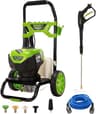
Read the spec tables below with that in mind and the ranking explains itself. The Greenworks 2300 publishes up to 2.3 GPM. The Active 2.0 publishes 2.0 GPM against an 1800 PSI peak — a machine deliberately built the way a detailer would build one. The Westinghouse WPX3000e publishes the biggest pressure figure on the page at 3000 PSI but only 1.76 GPM, the same flow as the Sun Joe at roughly 60 dollars less. If you were buying on the front of the box you would get those two the wrong way round.
1. Flow rate first
More gallons per minute means faster foam removal and less contact time with a mitt, which is where swirl marks come from. It is also what a foam cannon needs: Chemical Guys publishes a 1.4 GPM minimum and 2.0 GPM recommended for its Max Foam 8, which the 2300 and the Active 2.0 clear outright and the budget 1800 (1.1 GPM) does not. If thick foam is why you are buying, that single published figure decides the purchase. Our PSI and GPM page sets every machine against it.
2. Pressure, read as a ceiling rather than a target
A 3000 PSI machine is not more dangerous to paint than an 1800 PSI one if you use the right tip at the right distance. What it is, is more pressure you will deliberately never use on a car — headroom that only pays off on concrete, siding and a neglected patio. If you own those jobs too, the headroom is worth money. If you do not, you are paying for a number you will spend the whole wash avoiding.
3. The things that decide whether you enjoy owning it
Hose and cord length, where the machine stores, how the fittings feel on day two, and whether it has an onboard tank or wants a cannon. These never make the headline and they are most of the ownership experience. The Active 2.0 publishes a 24-pound weight and a 3/4-inch garden-hose inlet with an M22-14mm outlet, which is why it is the mobile pick: it goes in a trunk and it connects to anything. The Westinghouse ships a pro-style steel wand and a five-piece tip set. The Greenworks 2300 publishes a 25-foot hose, which is the longest here and means fewer trips to reposition the unit around a full-size SUV.
How much of the $500 to actually spend
Three honest scenarios, because this is the only decision on the page.
A car, and only ever a car. Spend about $140 on the Greenworks 1800 and put the difference into a cannon, a good mitt and grit guards. Those three do more for your paint than any amount of extra motor, and the 1800 is already sitting in the safe pressure window by design.
A car plus the driveway, the fence and the siding. This is the Greenworks 2300 or the Westinghouse, and it is the only scenario where spending past $250 is clearly rational. Our cars-and-home ranking argues that trade in full, and Greenworks 2300 vs Westinghouse WPX3000e is the head-to-head between this page’s top pick and the power pick.
Cars away from your own driveway.The Active 2.0. The published flow rate, the universal fittings and the 24-pound weight are the three things that matter when you are working off someone else’s tap or a tank, and our mobile detailing ranking explains why those beat raw pressure every time.
What $500 does not buy
It does not buy a gas machine worth owning, and we carry none — a serious gas unit starts above this cap and is the wrong tool for paint anyway, which gas vs electric covers. It does not buy a hot-water machine. And it does not buy you out of technique: the fastest way to damage a car with any machine on this page is a narrow tip held close, which costs nothing and ruins clear coat. Read the safe-PSI guide before the first wash, whichever one you buy.