Reason one: the accessory fitment nobody warns you about
This is the single most common reason a Kärcher owner ends up on a page like this, and it is a documented fact rather than an opinion. Kärcher runs two different connection systems. The European K2 to K7 machines use a proprietary bayonet fitting, while the US K1700 to K2300 range uses a quick-connect outlet. That means a lot of the foam cannons and lances sold as “for Kärcher” are built for the bayonet and will not fit a US K1700 — and Kärcher’s own documentation states that its FJ 6 foam nozzle does not fit the K1700 to K2300 machines.
It is solvable. The right adapter or a cannon with the correct connector gets you there, and our foam cannons for Kärcher page works through it brand by brand. But if the appeal of a pressure washer to you is buying any cannon on the shelf and having it click on, every machine on this page uses a standard quick-connect and does exactly that. Our fitment guide is the general version of the problem.
Reason two: flow rate, if foam is why you are buying
A foam cannon is fed by water volume, not pressure. Chemical Guys publishes a 1.4 GPM minimum and 2.0 GPM recommended for its Max Foam 8, and Adam’s publishes 870 PSI and 1.3 GPM for its cannon. The K1700’s published 1.2 GPM sits below both of those minimums, which does not mean no foam — it means thinner foam and a slower rinse.
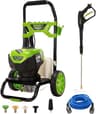
That is the clearest case for a change of machine rather than a change of accessory. The Sun Joe publishes 1.76 GPM, the Westinghouse 1.76 GPM and the Greenworks 2300 up to 2.3 GPM. If thick clinging snow foam is the thing you want from a pressure washer, buy flow. Our PSI and GPM page sets every machine we carry against the published cannon minimums, and the best washers for a foam cannon is the ranking built around it.
Reason three: price
The Greenworks 1800 is the cheapest machine in our registry and it washes a car perfectly safely: 1800 PSI, 1.1 GPM, PWMA certified. Compared with the Kärcher you give up a little flow and some fit-and-finish, and you keep the thing that actually matters on paint — a pressure in the gentle band and a wide tip. Our under-$200 ranking makes the full argument that cheap is fine for paint, and our under-$500 page covers what the extra money buys when you want it.
Where each alternative matches the original, and where it does not
Sun Joe SPX3000
Matches on: size, price bracket, car-focused design. Beats it on: published flow (1.76 GPM), the tip set (five quick-connect tips including 0, 15, 25, 40 and soap) and accessory compatibility. Gives up: the CETA certification and the Kärcher pump name, and its 2030 PSI is above the gentle band, so the wide tip and standoff distance matter more. Our Sun Joe vs Kärcher head-to-head is the long version of this comparison.
Greenworks 1800
Matches on: the gentle pressure band and PWMA-measured ratings. Beats it on: price. Gives up: flow (1.1 GPM is slightly under the K1700’s 1.2), hose and cord length, and the solid feel. This is the honest budget swap, not an upgrade.
Greenworks 2300
Matches on: nothing — this is a different class of machine. Beats it on: flow, by roughly double, plus a published 25-foot hose. Gives up: compactness and the car-only simplicity. Buy it if the driveway and the siding are also on your list; our cars-and-home ranking is where that decision lives.
Westinghouse WPX3000e
Matches on: the onboard detergent tank, which Kärcher owners tend to like. Beats it on: published pressure (3000 PSI) and the pro-style steel wand. Gives up: gentleness — this is the most pressure on the page and the least forgiving if you reach for a narrow tip. Same flow as the Sun Joe for more money, so buy it for the wand and the power, not for the car.
When to just buy the Kärcher
If your priorities are storage space, the gentlest machine on paint and a rating measured to a standard, the K1700 is still the right answer and no page on this site will tell you otherwise. Read the K1700 review and K1700 vs Active 2.0 before you switch on the strength of one spec. The point of this page is not that there is something wrong with the original — it is that three specific buyers are better served elsewhere, and all three of them arrive here looking for the same phrase.